
This week at the Seaquarium I began the day in the Seal cove; cleaning out the pens and feeding the harbour seals their morning treat. I watched another seal trainer, Gemma, perform the daily 11, 1 and 3 o’clock shows that day. It was interesting to see how she worked with the Seals. Gemma explained the importance of trainers not training the Seals too many days at a time. Just like humans, Seals can become bored repeating the same thing over and over. In this way they can become bored being trained by the same individual everyday. It can potentially lead to the Seals becoming annoyed and irritable which could lead to them refusing to participate in training sessions and unfortunately sometimes displaying aggressive behaviours e.g. biting their trainer. In the interests of the Seals and the marine mammal trainers, the aquarium ensures trainers are alternated throughout the week.
Later that day I was shown how to test the nitrate, nitrite, pH and ammonia of the indoor fish tanks. Incorrect levels of these can be fatal for fish so it’s extremely important they’re tested regularly. Myself and the aquarist Richard collected water from each tank to be tested. From each tanks water cup collected I syringed water up and put the water in 4 test tubes (one for each test). From there, using the water test kit provided, I added the nitrate test solution to one test tube per tank. This was repeated for each test. I put the tube cap on and shuck the liquid until it was completely mixed through. Using a water test colour chart I identified the levels of each test for each tank. I wrote my findings on a record chart. My findings were in a healthy range so there was no need for any action to be taken. If a high level of the four tested was found, the tanks would have to be drained and refilled.
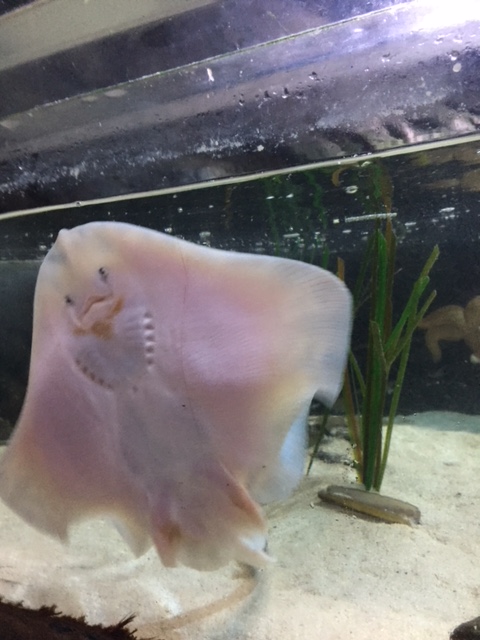
Below is an image of a baby ray whose tank water I’d tested that day (Plate 1.)
 Becky's blog