I observed a seal experience happen today at the Seaquarium. A mother and her child came to the Seaquarium during the morning for the experience they had booked with the harbour seals.
To begin, Gemma the marine mammal trainer went through all the health and safety procedures with the boy who was taking part. He had been to one previously, but it was still important to refresh his memory to make sure he, Gemma and the seals were all kept safe during the experience. Gemma gave the boy a life jacket to wear and checked that he was wearing appropriate safe shoes to wear by the slippery pool.
During the experience the boy stood on the beach by the harbour seal pool. He stood behind a wooden table which held a bucket of fish for him to feed to the seals. As he was feeding the seals, Gemma taught him several training techniques. One of these included getting the seals to hold their noses at the target stick, then rewarding them with fish. This is called positive reinforcement which is the way the trainers at the Seaquarium also train the seals themselves. If the seals doesn’t behave well, or ignores an instruction they are not punished for it whatsoever. Once the training and feed had been completed. The boy was able to pose for some photographs before he left.
Today at the Seaquarium I measured out the seal evening feed which required me to replenish the fridge with fish for the next few days. For each seal I ensured I inserted the correct amount of vitamins and iron tablets into the feed as instructed on the food charts.
During the afternoon I spent time indoors measuring out the ‘ocean day’ evening feed. I was also given a tub of measured out squid pieces to target feed to the terrapins, axolotl, cat fish and ray. The feed was taken well by all apart from the axolotl who found the squid pieces too large to consume. Axolotls are carnivores. However, their teeth only allow them the ability to grip onto their food, rather than tear it apart so the food they consume must be small enough for them to swallow hole (Axolotl, 2012) . I informed Katie that the axolotls were struggling to swallow the squid. She swapped the squid for smaller pieces of chopped up fish. This worked effectively as the axolotls were then able to eat them.
Nat, an aquarist at Seaquarium gave me the opportunity to observe the evening feed for Reggie the octopus. As Reggie is a classified as a category 1 dangerous animal, I wasn’t able to feed her myself but I was able to gain a better understanding of how and what she is fed.
Firstly, Nat placed two laminated picture cards in front of Reggie’s enclosure window which she has been trained to understand mean ‘play time’ and ‘feed time’. Next, we entered the back of the enclosure, an area which the public cannot see. As an octopus, Reggie is a natural hunter. A good way of enriching her environment is by providing her with containers in which her food is hidden. Before we headed to the enclosure, Nat showed me a bucket full of enrichment toys that are used when feeding Reggie. In the bucket were pipes, jars, puzzle type toys, and plastic toys with lids and small openings. Each day a different one is used to keep Reggie mentally stimulated. To get to her food, Reggie has to work out how to get into the enrichment toys. When enrichment is used in this way with octopuses, it increases natural behaviours shown because their natural hunting instincts have been initiated.
That day, Nat gave Reggie two crabs which were encased in a round egg shaped plastic container which could be taken apart by pulling it at both sides. Reggie interacted with her toy and took the crabs. Afterwards, Nat had non-food related interaction with Reggie. This mostly consisted of touching and playing with Reggie’s tentacles as Reggie reached out to touch Nat’s hand and forearm. Nat attempted to play with the tug-of-war rope and toy which Reggie had played with the day before. However, she didn’t seem interested to play with it for two days on the run. Octopuses have large beaks on their underside which can cause a lot of harm to human skin; Nat informed me about this and made sure to keep her distance from the area where it is located as precaution. The aim of using enrichment in this way when feeding and playing with Reggie is to encourage her to perform these exploratory behaviours in her enclosure by herself.
At the Seaquarium this week I was given the opportunity to target feed ray, baby shark, axolotl and the terrapins. I fed them either squid or chopped up fish using a large pair of tweezers. I attempted to target feed each individual of each of these species. If an individual didn’t want the feed I ensured that I didn’t leave the feed in the display to prevent the water becoming dirty. The technique to target feeding is to hold the food held by the tweezers slightly in front of the individuals face and allow them to choose whether to take it or not. I found most individuals within these species did take the food, however, the majority of the terrapins didn’t. I was reassured by one of the aquarists that this is not unusual for the terrapins at this time of year with the weather becoming colder.
During the day I spent time measuring out evening feeds for the inside aquarium tanks. In the evening I was then able to provide these feeds to the majority of the tanks. One of the aquarists Nat showed me how to correctly feed flakes. She told me that in order to give an even spread of flakes in each tank, you should scoop the cup holding the flakes in and out of the water which allow all fish the opportunity to eat.
After feeding species within the aquarium I was then given the opportunity to feed the African fur seals and harbour seals before they went either into their pens or night pool before the aquarium closes. The marine mammal trainer first brought the fur seals into their pens. Each seal has a pen of their own. On the door of each pen is a square hole were I was able to feed each of them their heron/mackerel. Gaz the trainer told me to feed them leading with the fish tail end first. I fed each of them by hand. One of elderly seals is blind so at times I had to call her name so she knew I was still trying to feed her. She was able to use her incredibly sensitive whiskers to detect where the fish I was feeding her was.
After the fur seals were fed, Gaz brought the harbour seals into the nursery pool were they remain once the aquarium is closed. We both fed the seals by throwing the fish for them to catch. We had to try our best to ensure each seal got the feed measured out for each of them individually. Their feeds are measured out depend on their age and weight so each varies in grams. Once the seals were fed, Gaz ensured the seals were locked up safely ready for close.
Today at the seaquarium I observed one of the African fur seals have eye drops put into one of her eyes. They were given to an elderly seal who had previously undergone cataract surgery. Vision deterioration is common in elderly pinnipeds, especially those living in captivity. This is due to the chlorine put in the pools that keep them clean. Part of the marine mammal trainers role is to check chlorine levels daily. If chlorine levels are at a level considered harmful; the seals must be removed from the pool for a water change.
The seal dealt with being given the eye drops extremely well. This is due to the behaviour training given to them. Training behaviours that seals perform at shows are natural behaviours that they would show in the wild and behaviours that allow health checks to take place safely e.g. seal opening his/her mouth for dental checks. The eye drops are medically prescribed from the vet therefore its important that the seals are comfortable in performing the health check behaviours so they’re able to receive the treatment they may need.
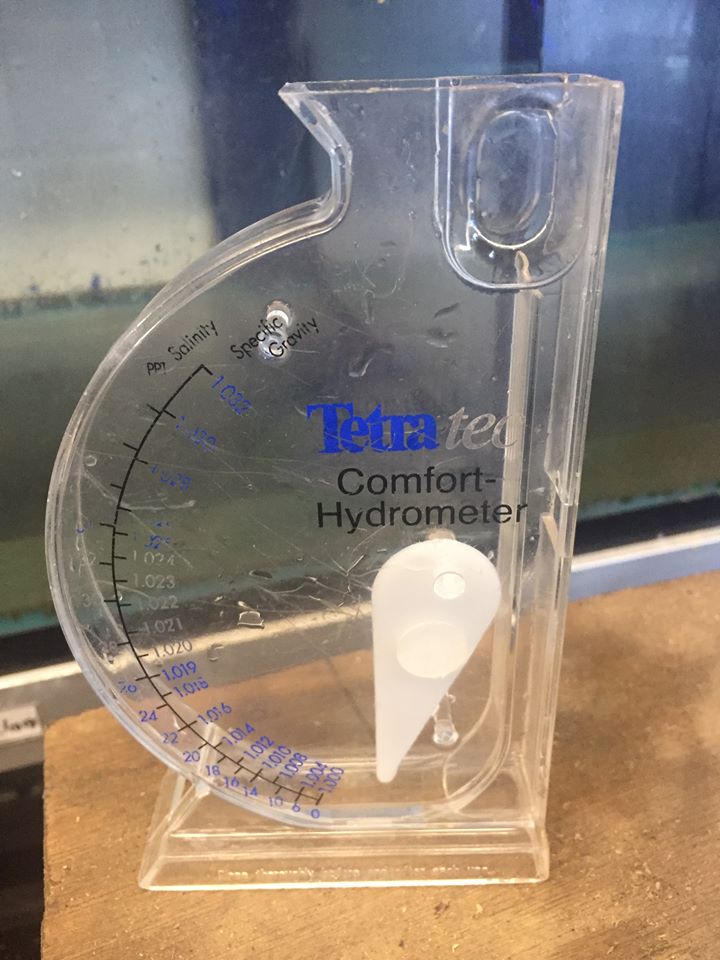
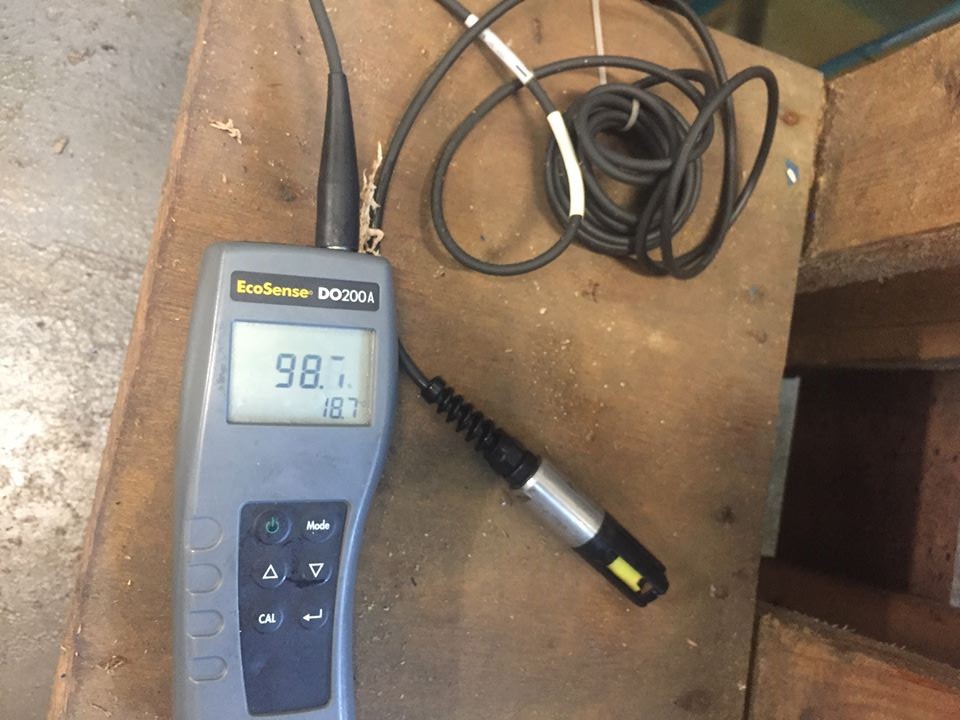
At the seaquarium I learn’t how to test the fish tanks for saline, temperature and oxygen levels. I was able to do this with the machine and apparatus provided to me from the aquarists. The machine I used told me the oxygen and temperature levels and another piece of equipment I used which collected water indicated the salinity. The aquarist Richard told me if the oxygen has dropped below 80% then it is unsafe and needs to be brought to attention. The temperature and salinity of each fish tank can be very different dependant on the type of species which live within them. It’s important to monitor and check tank conditions day to day for the safety of the animals. I did this by recording my findings on the paper work provided to me. I was able to compare what I found to what had been found the day before. Had I found the levels had dramatically changed from the day before, I would know to have alerted Richard about this.
The images below show the apparatus I used to test the water at the Seaquarium (Plates 1 and 2)
Plate 1. Image of comfort hydrometer used to test water salinity (Authors own, 2019)Plate 2. Image of the piece of equipment used at Seaquarium Rhyl used to test water temperature and oxygen levels (Authors own, 2019)
This week at the Seaquarium I began the day in the Seal cove; cleaning out the pens and feeding the harbour seals their morning treat. I watched another seal trainer, Gemma, perform the daily 11, 1 and 3 o’clock shows that day. It was interesting to see how she worked with the Seals. Gemma explained the importance of trainers not training the Seals too many days at a time. Just like humans, Seals can become bored repeating the same thing over and over. In this way they can become bored being trained by the same individual everyday. It can potentially lead to the Seals becoming annoyed and irritable which could lead to them refusing to participate in training sessions and unfortunately sometimes displaying aggressive behaviours e.g. biting their trainer. In the interests of the Seals and the marine mammal trainers, the aquarium ensures trainers are alternated throughout the week.
Later that day I was shown how to test the nitrate, nitrite, pH and ammonia of the indoor fish tanks. Incorrect levels of these can be fatal for fish so it’s extremely important they’re tested regularly. Myself and the aquarist Richard collected water from each tank to be tested. From each tanks water cup collected I syringed water up and put the water in 4 test tubes (one for each test). From there, using the water test kit provided, I added the nitrate test solution to one test tube per tank. This was repeated for each test. I put the tube cap on and shuck the liquid until it was completely mixed through. Using a water test colour chart I identified the levels of each test for each tank. I wrote my findings on a record chart. My findings were in a healthy range so there was no need for any action to be taken. If a high level of the four tested was found, the tanks would have to be drained and refilled.
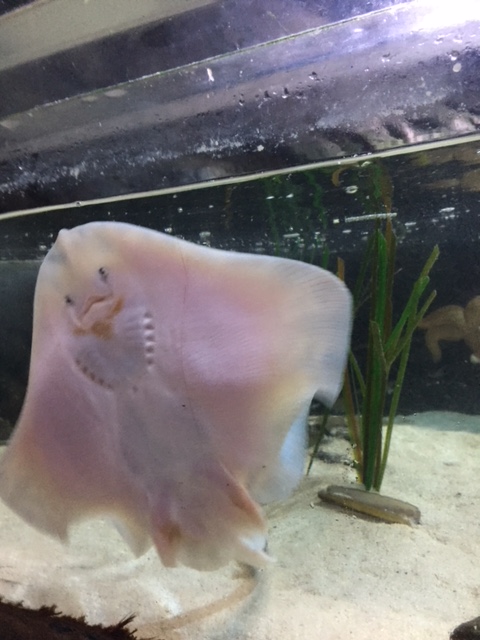
Below is an image of a baby ray whose tank water I’d tested that day (Plate 1.)
Plate 1. Image of baby ray at Seaquarium Rhyl (Authors own, 2019)
On 5th November, I had my induction day at Seaquarium in Rhyl. I was greeted by the marine mammals manger – Katie. She took me on a tour of the aquarium and informed me of the various fire exits, fire extinguishers and break glass to be aware of in case of an emergency. I was given a health and safety booklet and questionnaire to read through and complete before the day began.
To begin the day, Katie explained how the Seals pens are cleaned out, showing me the equipment and PPE (Personal Protective Equipment) that must be used. First the seal faeces were removed, then I put on the PPE provided (a mask) and jet washed the whole play pen area. Using disinfectant, I cleaned the whole play pen area with a brush. Cleaning every pen, every wall and all areas of the floor. Lastly, I jet washed off all the disinfectant.
After this, I joined another member of the team called Nat who had the responsibility for the public harbour seal feed at 11 a.m. She began by giving a talk about the harbour seals. She pointed out each seal, saying what each of their names was. Their names being; Ina, Pamina and Wanda. Nat went on to explain where they can be found in the wild, what they feed on, how they behave and how they differ from sea lions. From there, she told the participants the health and safety rules of the public feed to ensure that they didn’t put themselves in any dangerous situations which could risk their health. In cups were fishy treats that were given to each participants to feed the seals with. Nat even gave me a cup, so I had the privilege of being able to feed them also!
I observed two seal shows Katie and Nat took part in that day. During the shows, Katie explained how training the seals is not only used to provide good enrichment for them during the day, but how it helps the seals cope with health and medical checks when they need them. This was proven to me during the day when I observed Katie and Nat put eye drops in one of the African fur seals eyes. They needed to capture a photo of the eye with tinted eye drops on to send to the vet. Katie informed me that the seal has been suffering with an ulcer in her eye, so it was important to get the photo for the vet could take a look. The seal dealt with the eye drops very well and I believe both training and the relationship between the seal and trainers largely contributed to this.
For the final part of the day, I used the feeding board to measure the amount of Herring each harbour seal required for their evening feed. The feeding board displays the exact amount of Herring or Mackerel in grams each seal has during every feed within a day. As well as food, the board indicated the number of vitamins and iron tablets each seal needed per day. I counted out what each seal needed and using gloves; I inserted the tablets through the Herrings gills to allow the seals to ingest them easily.
I thoroughly enjoyed my first day at the Seaquarium! I learnt a lot from the aquarists and trainers there. I’m really looking forward to learning more and gaining further experience.
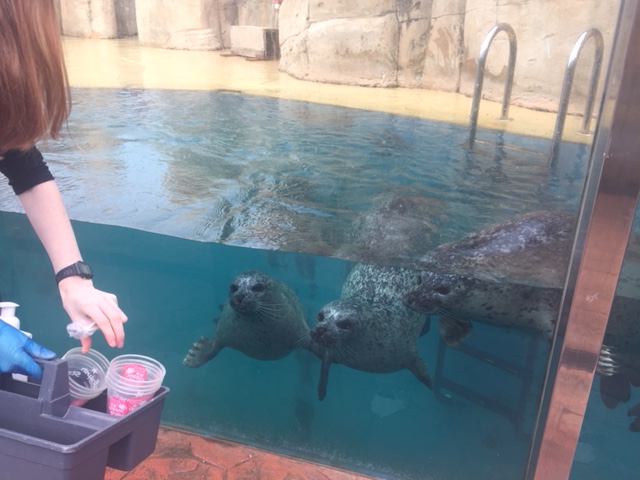
(Plate 1 is a photo of the harbour seals at the seaquarium.)
Plate 1. The harbour seals at Seaquarium Rhyl (Authors own, 2018)
To continue from my previous post – I received an email from the Senior Aquarist at the Seaquarium to say I’d been successful in getting a position for the Marine Mammal work experience! I was thrilled to hear this news. I was informed that my induction would begin on 5th November and I would be working on Mondays 10am-4pm for 2 months. This means from that date I can finally begin to develop the necessary skills I need to work in this field of animal care. I am incredibly excited to start and will continue to update my blog on my progress at the Seaquarium.
Below are screen shots (Plates 1 and 2) of the email I received from the senior aquarist at Seaquarium Rhyl offering me the placement position.
Plate 1. Image of the email detailing placement offer at Seaquarium Rhyl (Authors own, 2018)
Plate 2. Image of the email detailing placement offer from Seaquarium Rhyl (Authors own, 2019)
On Sunday 21st October I drove to Rhyll for an interview at Seaquarium. The interview took place at 11:30am. I was greeted by the Senior Aquarist Gaz Mead.
He asked me:
Why I wanted to gain work experience at the Seaquarium? Why Seaquarium should offer me the work experience role? Why I chose to apply specifically for the Marine Mammal work experience? What University or College I attended? What day I could work at the Seaquarium?
..and various other questions. Before I left, he told me I would be contacted by email if I had been successful or not by Tuesday 23rd October.
After the interview I took the opportunity to spend the day exploring the Seaquarium as I hadn’t ever visited before. The aquatic animals I got to see where fascinating and I learnt a lot from the educational information boards displayed around all the enclosures. At 13:00 I got to see the Seal show! This was particularly of interest to me as the Marine Mammal work experience involves working in the Seal enclosures. The show was informative and entertaining. There was a good focus on the harm plastics are doing to marine life which I thought was very important.
Below are images which display some of the aquatic life and enclosures I saw at Seaquarium (Plates 1, 2 and 3)
Plate 1. Image of the terrapins at Seaquarium Rhyl (Authors own, 2019)
Plate 2. Image of aquatic life at the Seaquarium Rhyl (Authors own, 2019)
Plate 3. Image of aquatic life at Seaquarium Rhyl (Authors own, 2019)



 Becky's blog